• What Is a “Vibe Check”? (And Did You Pass?)

    As an English teacher, I have been creating content for both Korean learners and global English learners. This blog is where I share the expressions and slang I cover in my lessons — and today’s word is one that perfectly captures Gen Z energy: “Vibe check.”


    What does “vibe check” mean?

    A “vibe check” means checking the energy or mood of a person, place, or situation.

    When someone does a vibe check, they’re assessing whether the energy feels good, bad, off, or right.

    Passing a vibe check = your energy is good ✅ Failing a vibe check = your energy is off ❌


    Real life examples:

    1. “Vibe check — how is everyone feeling today?”
    2. “I did a vibe check on the new coworker and he passed.”
    3. “This party failed the vibe check — let’s leave.”
    4. “She walked in and immediately failed the vibe check.”
    5. “Vibe check: this coffee shop gets a 10/10.”

    How to use it:

    • As a noun: “This place has great vibes.
    • As a check: “Vibe check — are you okay?”
    • As a verdict: “You passed the vibe check.

    Where did it come from?

    “Vibe check” exploded on social media around 2019-2020, especially on Twitter and TikTok. It started as a joke format — randomly checking someone’s vibe — and quickly became part of everyday Gen Z vocabulary.


    Similar expressions:

    • “Good vibes only” — only positive energy welcome
    • “Off vibes” — something feels wrong or uncomfortable
    • “Read the room” — understand the energy of a situation

    Quick recap:

    Vibe check = checking the energy or mood of something or someone. Pass = good energy. Fail = something’s off. Use it to describe the feeling a place, person, or moment gives you! ✨


    Want to learn more natural English?

    Hi, I’m Yehs Sam 👋 I have been teaching English and creating content to help learners sound more natural and confident — for both Korean learners and global English learners.

    🐢⚡ Turtle ZeusSlow but surely, we get there.


    Is there a slang word or English expression you’ve always wanted to know? Drop it in the comments below — I’d love to cover it in my next post!

  • What Does “Slay” Mean? (And How to Use It Like a Native)

    As an English teacher, I have been creating content for both Korean learners and global English learners. This blog is where I share the expressions and slang I cover in my lessons — and today’s word is one that went from niche to absolutely everywhere: “Slay.”


    What does “slay” mean?

    “Slay” means to do something exceptionally well — to absolutely nail it.

    When someone slays, they look amazing, perform brilliantly, or handle something with total confidence and style.

    It’s one of the highest compliments in Gen Z English. 👑


    Real life examples:

    1. “She walked into the room and absolutely slayed.”
    2. “Your presentation today? You slayed it.”
    3. “That outfit is everything — you’re slaying!”
    4. “She slayed the interview and got the job.”
    5. “Beyoncé always slays no matter what she does.”

    How to use it:

    • As a verb: “She slayed the performance.”
    • As a reaction: “Slay!” (used alone to hype someone up)
    • As a compliment: “You’re slaying that look.”

    Where did it come from?

    Like many Gen Z expressions, “slay” comes from African American and LGBTQ+ ballroom culture. It was used to describe performers who completely owned the stage. Social media — especially TikTok and Instagram — brought it mainstream around 2022.


    Similar expressions:

    • “Killed it” — did something really well
    • “Nailed it” — executed something perfectly
    • “Ate and left no crumbs” — did something so well there’s nothing left to critique

    Quick recap:

    Slay = do something amazingly well, look incredible, own the moment. Use it to hype yourself up or compliment someone else. Simple, powerful, and very now! 👑


    Want to learn more natural English?

    Hi, I’m Yehs Sam 👋 I have been teaching English and creating content to help learners sound more natural and confident — for both Korean learners and global English learners.

    🐢⚡ Turtle ZeusSlow but surely, we get there.


    Is there a slang word or English expression you’ve always wanted to know? Drop it in the comments below — I’d love to cover it in my next post!

  • What Does “It’s Giving” Mean? (Very Gen Z Slang)

    As an English teacher, I have been creating content for both Korean learners and global English learners. This blog is where I share the expressions and slang I cover in my lessons — and today’s word is one of the most creative Gen Z expressions out there: “It’s giving.”


    What does “it’s giving” mean?

    “It’s giving” means something has a certain vibe, energy, or feeling.

    When you say “it’s giving ___” you’re saying that something reminds you of, or feels like, something else.

    It’s a way of describing the energy or mood of a person, place, outfit, or situation.


    Real life examples:

    1. “That outfit? It’s giving main character energy.”
    2. “This coffee shop is so cozy — it’s giving autumn vibes.”
    3. “The way she walked in — it’s giving boss lady.”
    4. “This movie is giving early 2000s romance.”
    5. “His apartment? It’s giving minimalist luxury.”

    How to use it:

    “It’s giving” + the vibe, energy, or feeling you want to describe

    • “It’s giving summer.”
    • “It’s giving chaos.”
    • “It’s giving total confidence.”

    You don’t always need to finish the sentence — sometimes just “it’s giving” alone means “this has a vibe” ✅


    Where did it come from?

    “It’s giving” comes from African American and LGBTQ+ ballroom culture, popularized through social media and platforms like TikTok around 2021-2022. It spread globally almost overnight.


    Similar expressions:

    • “That’s the vibe” — similar energy
    • “Main character energy” — feeling like the star of the moment
    • “Giving me ___” — older version of the same expression

    Quick recap:

    It’s giving = this has a certain vibe or energy. Use it to describe the feeling something gives you — outfits, places, people, moments. Very TikTok, very now! ✨


    Want to learn more natural English?

    Hi, I’m Yehs Sam 👋 I have been teaching English and creating content to help learners sound more natural and confident — for both Korean learners and global English learners.

    🐢⚡ Turtle ZeusSlow but surely, we get there.


    Is there a slang word or English expression you’ve always wanted to know? Drop it in the comments below — I’d love to cover it in my next post!

  • What Does “Lowkey” Mean? (And How to Use It)

    As an English teacher, I have been creating content for both Korean learners and global English learners. This blog is where I share the expressions and slang I cover in my lessons — and today’s word is one that sounds simple but has a really interesting meaning: “Lowkey.”


    What does “lowkey” mean?

    “Lowkey” means secretly, quietly, or a little bit — something you feel or think but don’t want to make a big deal about.

    It’s the opposite of “highkey” — which means openly, obviously, or a lot.


    Real life examples:

    1. “I lowkey love this song even though it’s embarrassing to admit.”
    2. “She’s lowkey the best player on the team.”
    3. “I’m lowkey stressed about the exam tomorrow.”
    4. “He lowkey likes her but won’t say it out loud.”
    5. “That restaurant is lowkey one of the best in the city.”

    Lowkey vs Highkey:

    • “I’m lowkey tired.” → a little tired, not making a big deal
    • “I’m highkey exhausted.” → very tired, openly admitting it

    How to use it:

    Put “lowkey” before the adjective or verb:

    • “I lowkey want to cancel my plans tonight.”
    • “This is lowkey the best day ever.”

    Where did it come from?

    “Lowkey” originally meant keeping something quiet or under the radar. Over time Gen Z turned it into a way of admitting something you feel but don’t want to fully own out loud.


    Similar expressions:

    • “Kind of / Kinda” — similar meaning, slightly less cool 😄
    • “Lowkey obsessed” — secretly really into something
    • “Highkey” — the opposite, openly and obviously

    Quick recap:

    Lowkey = secretly, quietly, a little bit. Use it when you want to admit something without making it a big deal. Very natural, very Gen Z! 🔑


    Want to learn more natural English?

    Hi, I’m Yehs Sam 👋 I have been teaching English and creating content to help learners sound more natural and confident — for both Korean learners and global English learners.

    🐢⚡ Turtle ZeusSlow but surely, we get there.


    Is there a slang word or English expression you’ve always wanted to know? Drop it in the comments below — I’d love to cover it in my next post!

  • What Does “No Cap” Mean? (And How to Use It)

    As an English teacher, I have been creating content for both Korean learners and global English learners. This blog is where I share the expressions and slang I cover in my lessons — and today’s word is one you’ll hear constantly from younger English speakers: “No cap.”


    What does “no cap” mean?

    “No cap” means “I’m not lying” or “seriously, I mean it.”

    When someone says “no cap” they’re telling you that what they just said is 100% true — no exaggeration, no joke.

    The opposite is “capping” — which means lying or exaggerating.


    Real life examples:

    1. “That was the best meal I’ve ever had, no cap.”
    2. “No cap, she’s the most talented person I know.”
    3. “I finished the whole pizza by myself, no cap.”
    4. “He said he doesn’t care but he’s totally capping.”
    5. “No cap, this song has been on repeat all week.”

    How to use it:

    You can put “no cap” at the beginning or end of a sentence:

    • “No cap, that movie was incredible.”
    • “That movie was incredible, no cap.”

    Both are totally natural! ✅


    Where did it come from?

    “No cap” comes from African American Vernacular English (AAVE) and became mainstream through hip-hop culture and social media around 2017-2018. Today it’s used by Gen Z all over the world.


    Similar expressions:

    • “For real” — same meaning, slightly older
    • “Deadass” — New York slang for seriously/honestly
    • “On God” — I swear, this is true

    Quick recap:

    No cap = I’m not lying, I mean it. Capping = lying or exaggerating. Simple, fun, and very Gen Z! 🧢


    Want to learn more natural English?

    Hi, I’m Yehs Sam 👋 I have been teaching English and creating content to help learners sound more natural and confident — for both Korean learners and global English learners.

    🐢⚡ Turtle ZeusSlow but surely, we get there.


    Is there a slang word or English expression you’ve always wanted to know? Drop it in the comments below — I’d love to cover it in my next post!

  • “By vs Until” — Can You Get All 5 Right? (Preposition Quiz)

    As an English teacher, I have been creating content for both Korean learners and global English learners. This blog is where I share the grammar rules I cover in my lessons — and today’s quiz is about two words that confuse even advanced English learners: by and until.

    No rules first. Just the quiz. 👇


    Quiz Time! 🎯


    Question 1: “Please finish the report ___ Friday.”

    a) until b) by c) both work


    Question 2: “I will wait here ___ you come back.”

    a) by b) until c) both work


    Question 3: “She studied ___ midnight.”

    a) by b) until c) both work


    Question 4: “Can you send me the file ___ 3pm?”

    a) until b) by c) both work


    Question 5: “He didn’t leave ___ the meeting was over.”

    a) by b) until c) both work


    Drop your answers in the comments! 👇


    Now let’s check! 🎉


    Q1: b) by “Please finish the report by Friday.” → BY = deadline (finish it at any point before Friday — but not after)


    Q2: b) until “I will wait here until you come back.” → UNTIL = continuous action up to a point (waiting the whole time until you return)


    Q3: b) until “She studied until midnight.” → UNTIL = continuous action (she kept studying the whole time up to midnight)


    Q4: b) by “Can you send me the file by 3pm?” → BY = deadline (send it anytime before 3pm)


    Q5: b) until “He didn’t leave until the meeting was over.” → UNTIL = continuous state up to a point (he stayed the whole time until it ended)


    The simple rule 🔍

    • BY = deadline → do it before this time
    • UNTIL = continuous → keep doing it up to this time

    Ask yourself: is it a deadline or a continuous action? Deadline → BY Continuous → UNTIL


    How did you score?

    • 5/5 → Grammar pro! 🏆
    • 3-4/5 → Almost there! 💪
    • 1-2/5 → Now you know — try again! 😊

    Drop your score in the comments! 👇


    Want to learn more natural English?

    Hi, I’m Yehs Sam 👋 I have been teaching English and creating content to help learners sound more natural and confident — for both Korean learners and global English learners.

    🐢⚡ Turtle ZeusSlow but surely, we get there.


    Is there a slang word or English expression you’ve always wanted to know? Drop it in the comments below — I’d love to cover it in my next post!

  • “In vs Into” — Can You Get All 5 Right? (Preposition Quiz)

    As an English teacher, I have been creating content for both Korean learners and global English learners. This blog is where I share the grammar rules I cover in my lessons — and today’s quiz is about two words that look almost identical but mean something very different: in and into.

    No rules first. Just the quiz. 👇


    Quiz Time! 🎯


    Question 1: “She walked ___ the room.”

    a) in b) into c) both work


    Question 2: “He is sitting ___ the car.”

    a) into b) in c) both work


    Question 3: “The cat jumped ___ the box.”

    a) in b) into c) both work


    Question 4: “I left my keys ___ the kitchen.”

    a) into b) in c) both work


    Question 5: “She poured the water ___ the glass.”

    a) in b) into c) both work


    Drop your answers in the comments! 👇


    Now let’s check! 🎉


    Q1: b) into “She walked into the room.” → INTO = movement from outside to inside (she was outside, now she’s inside)


    Q2: b) in “He is sitting in the car.” → IN = already inside, no movement (he’s already there)


    Q3: b) into “The cat jumped into the box.” → INTO = movement (the cat moved from outside the box to inside)


    Q4: b) in “I left my keys in the kitchen.” → IN = location, no movement (the keys are just sitting there)


    Q5: b) into “She poured the water into the glass.” → INTO = movement (water moved from outside to inside the glass)


    The simple rule 🔍

    • IN = already inside, no movement → state
    • INTO = moving from outside to inside → action

    Ask yourself: is something moving or staying? Moving → INTO Staying → IN


    How did you score?

    • 5/5 → Grammar pro! 🏆
    • 3-4/5 → Almost there! 💪
    • 1-2/5 → Now you know — try again! 😊

    Drop your score in the comments! 👇


    Want to learn more natural English?

    Hi, I’m Yehs Sam 👋 I have been teaching English and creating content to help learners sound more natural and confident — for both Korean learners and global English learners.

    🐢⚡ Turtle ZeusSlow but surely, we get there.


    Is there a slang word or English expression you’ve always wanted to know? Drop it in the comments below — I’d love to cover it in my next post!
  • “To vs For” — Can You Get All 5 Right? (Preposition Quiz)

    As an English teacher, I have been creating content for both Korean learners and global English learners. This blog is where I share the grammar rules I cover in my lessons — and today’s quiz is about two words that look simple but trip people up all the time: to and for.

    No rules first. Just the quiz. 👇


    Quiz Time! 🎯


    Question 1: “I bought this gift ___ you.”

    a) to b) for c) both work


    Question 2: “She explained the answer ___ me.”

    a) for b) to c) both work


    Question 3: “He went to the store ___ some milk.”

    a) to b) for c) both work


    Question 4: “Can you do this favor ___ me?”

    a) to b) for c) both work


    Question 5: “I sent a message ___ her.”

    a) for b) to c) both work


    Drop your answers in the comments! 👇


    Now let’s check! 🎉


    Q1: b) for “I bought this gift for you.” → FOR = benefit (you benefit from receiving the gift)


    Q2: b) to “She explained the answer to me.” → TO = direction of communication (the explanation went toward me)


    Q3: b) for “He went to the store for some milk.” → FOR = purpose (milk is the reason he went)


    Q4: b) for “Can you do this favor for me?” → FOR = benefit (doing something that helps me)


    Q5: b) to “I sent a message to her.” → TO = direction (the message traveled toward her)


    The simple rule 🔍

    • TO = direction → something moves toward someone
    • FOR = benefit or purpose → someone gains something or there’s a reason

    How did you score?

    • 5/5 → Grammar pro! 🏆
    • 3-4/5 → Almost there! 💪
    • 1-2/5 → Now you know — try again! 😊

    Drop your score in the comments! 👇


    Want to learn more natural English?

    Hi, I’m Yehs Sam 👋 I have been teaching English and creating content to help learners sound more natural and confident — for both Korean learners and global English learners.

    🐢⚡ Turtle ZeusSlow but surely, we get there.


    Is there a slang word or English expression you’ve always wanted to know? Drop it in the comments below — I’d love to cover it in my next post!

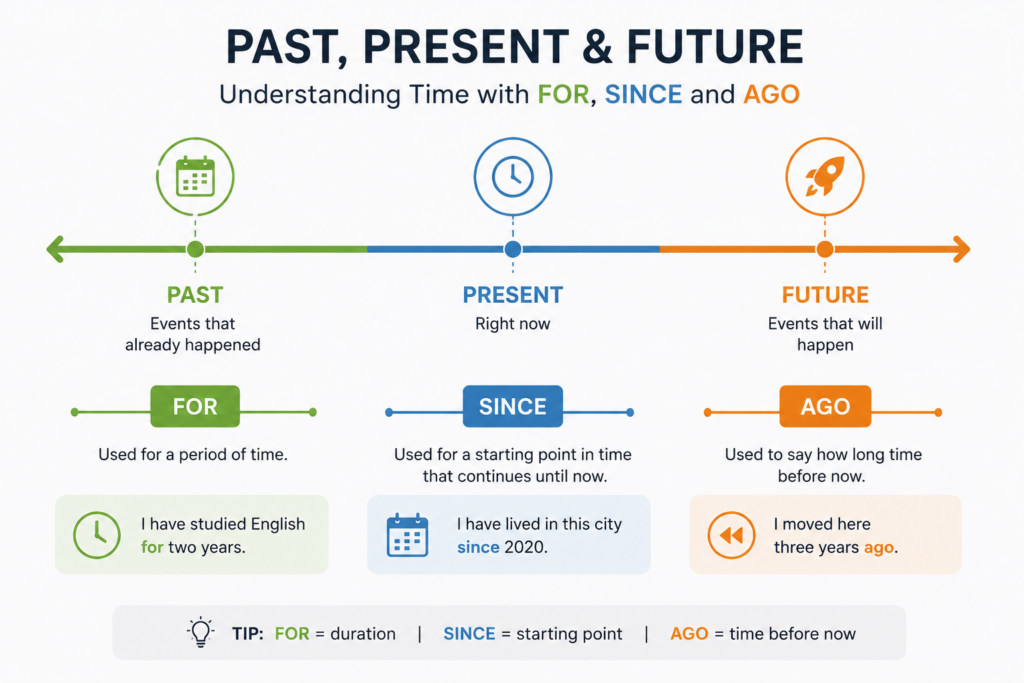
  • “For, Since, Ago” — Can You Get All 5 Right? (Preposition Quiz)

    As an English teacher, I have been creating content for both Korean learners and global English learners. This blog is where I share the grammar rules I cover in my lessons — and today’s quiz is about three words that confuse almost every English learner: for, since, and ago.

    No rules first. Just the quiz. 👇


    Quiz Time! 🎯


    Question 1: “I have lived here ___ 2019.”

    a) for b) ago c) since


    Question 2: “She left ___ two hours ___.”

    a) since / ago b) two / for c) — / ago


    Question 3: “I haven’t eaten ___ three hours.”

    a) since b) for c) ago


    Question 4: “He started learning English ___ he was a child.”

    a) ago b) for c) since


    Question 5: “We met a long time ___.”

    a) since b) for c) ago


    Drop your answers in the comments! 👇


    Now let’s check! 🎉


    Q1: c) since “I have lived here since 2019.” → SINCE = specific point in time (2019 is a fixed moment)


    Q2: c) — / ago “She left two hours ago.” → AGO = looking back from now (two hours back in time)


    Q3: b) for “I haven’t eaten for three hours.” → FOR = duration (three hours is a length of time)


    Q4: c) since “He started learning English since he was a child.” → SINCE = from a point in time continuing to now


    Q5: c) ago “We met a long time ago.” → AGO = a point in the past, looking back from now


    The simple rule 🔍

    • FOR = duration → “for three hours / for two years”
    • SINCE = specific starting point → “since 2019 / since Monday”
    • AGO = looking back from now → “two hours ago / a long time ago”

    How did you score?

    • 5/5 → Grammar pro! 🏆
    • 3-4/5 → Almost there! 💪
    • 1-2/5 → Now you know — try again! 😊

    Drop your score in the comments! 👇


    Want to learn more natural English?

    Hi, I’m Yehs Sam 👋 I have been teaching English and creating content to help learners sound more natural and confident — for both Korean learners and global English learners.

    🐢⚡ Turtle ZeusSlow but surely, we get there.


    Is there a slang word or English expression you’ve always wanted to know? Drop it in the comments below — I’d love to cover it in my next post!

  • “In, On, At” — Can You Get All 5 Right? (Preposition Quiz)

    As an English teacher, I have been creating content for both Korean learners and global English learners. This blog is where I share the grammar rules I cover in my lessons — and today we’re doing something a little different.

    No rules first. No hints.

    Just you and the quiz. Let’s see how you do. 👇


    Quiz Time! 🎯

    Fill in the blank with in, on, or at.


    Question 1: “I’ll meet you ___ 3pm ___ Monday.”

    a) in / on b) at / on c) on / at


    Question 2: “She was born ___ 1995 ___ a rainy Tuesday.”

    a) in / on b) on / at c) at / in


    Question 3: “The keys are ___ the table ___ the kitchen.”

    a) at / in b) in / on c) on / in


    Question 4: “I always study ___ night ___ my room.”

    a) on / in b) at / in c) in / at


    Question 5: “We arrived ___ the airport ___ the morning.”

    a) at / in b) in / on c) on / at


    How many did you get? Drop your answers in the comments! 👇


    Now let’s check! 🎉


    Q1: b) at / on

    “I’ll meet you at 3pm on Monday.”

    AT = exact time (3pm is a specific point on the clock) → ON = specific day (Monday is a named day)


    Q2: a) in / on

    “She was born in 1995 on a rainy Tuesday.”

    IN = year (big time period — think zoom out) → ON = specific day (Tuesday is a named day)


    Q3: c) on / in

    “The keys are on the table in the kitchen.”

    ON = surface (the table is a flat surface) → IN = enclosed space (the kitchen is a room)


    Q4: b) at / in

    “I always study at night in my room.”

    AT = night (a specific time period, treated as a point) → IN = enclosed space (your room has walls around it)


    Q5: a) at / in

    “We arrived at the airport in the morning.”

    AT = specific location (the airport is a point on a map) → IN = general time period (morning is a broad time)


    The zoom lens trick 🔍

    Now that you’ve seen the answers:

    • IN = big picture → years, months, cities, enclosed spaces
    • ON = medium → specific days, dates, surfaces
    • AT = exact point → specific times, specific locations

    Next time you’re unsure — zoom in or zoom out. The right preposition will follow!


    How did you score?

    • 5/5 → Grammar pro! 🏆
    • 3-4/5 → Almost there! 💪
    • 1-2/5 → Now you know — try again! 😊

    Drop your score in the comments! Which one surprised you the most? 👇


    Want to learn more natural English?

    Hi, I’m Yehs Sam 👋 I have been teaching English and creating content to help learners sound more natural and confident — for both Korean learners and global English learners.

    🐢⚡ Turtle ZeusSlow but surely, we get there.


    Is there a slang word or English expression you’ve always wanted to know? Drop it in the comments below — I’d love to cover it in my next post!