• “By vs Until” — Can You Get All 5 Right? (Preposition Quiz)

    As an English teacher, I have been creating content for both Korean learners and global English learners. This blog is where I share the grammar rules I cover in my lessons — and today’s quiz is about two words that confuse even advanced English learners: by and until.

    No rules first. Just the quiz. 👇


    Quiz Time! 🎯


    Question 1: “Please finish the report ___ Friday.”

    a) until b) by c) both work


    Question 2: “I will wait here ___ you come back.”

    a) by b) until c) both work


    Question 3: “She studied ___ midnight.”

    a) by b) until c) both work


    Question 4: “Can you send me the file ___ 3pm?”

    a) until b) by c) both work


    Question 5: “He didn’t leave ___ the meeting was over.”

    a) by b) until c) both work


    Drop your answers in the comments! 👇


    Now let’s check! 🎉


    Q1: b) by “Please finish the report by Friday.” → BY = deadline (finish it at any point before Friday — but not after)


    Q2: b) until “I will wait here until you come back.” → UNTIL = continuous action up to a point (waiting the whole time until you return)


    Q3: b) until “She studied until midnight.” → UNTIL = continuous action (she kept studying the whole time up to midnight)


    Q4: b) by “Can you send me the file by 3pm?” → BY = deadline (send it anytime before 3pm)


    Q5: b) until “He didn’t leave until the meeting was over.” → UNTIL = continuous state up to a point (he stayed the whole time until it ended)


    The simple rule 🔍

    • BY = deadline → do it before this time
    • UNTIL = continuous → keep doing it up to this time

    Ask yourself: is it a deadline or a continuous action? Deadline → BY Continuous → UNTIL


    How did you score?

    • 5/5 → Grammar pro! 🏆
    • 3-4/5 → Almost there! 💪
    • 1-2/5 → Now you know — try again! 😊

    Drop your score in the comments! 👇


    Want to learn more natural English?

    Hi, I’m Yehs Sam 👋 I have been teaching English and creating content to help learners sound more natural and confident — for both Korean learners and global English learners.

    🐢⚡ Turtle ZeusSlow but surely, we get there.


    Is there a slang word or English expression you’ve always wanted to know? Drop it in the comments below — I’d love to cover it in my next post!

  • “In vs Into” — Can You Get All 5 Right? (Preposition Quiz)

    As an English teacher, I have been creating content for both Korean learners and global English learners. This blog is where I share the grammar rules I cover in my lessons — and today’s quiz is about two words that look almost identical but mean something very different: in and into.

    No rules first. Just the quiz. 👇


    Quiz Time! 🎯


    Question 1: “She walked ___ the room.”

    a) in b) into c) both work


    Question 2: “He is sitting ___ the car.”

    a) into b) in c) both work


    Question 3: “The cat jumped ___ the box.”

    a) in b) into c) both work


    Question 4: “I left my keys ___ the kitchen.”

    a) into b) in c) both work


    Question 5: “She poured the water ___ the glass.”

    a) in b) into c) both work


    Drop your answers in the comments! 👇


    Now let’s check! 🎉


    Q1: b) into “She walked into the room.” → INTO = movement from outside to inside (she was outside, now she’s inside)


    Q2: b) in “He is sitting in the car.” → IN = already inside, no movement (he’s already there)


    Q3: b) into “The cat jumped into the box.” → INTO = movement (the cat moved from outside the box to inside)


    Q4: b) in “I left my keys in the kitchen.” → IN = location, no movement (the keys are just sitting there)


    Q5: b) into “She poured the water into the glass.” → INTO = movement (water moved from outside to inside the glass)


    The simple rule 🔍

    • IN = already inside, no movement → state
    • INTO = moving from outside to inside → action

    Ask yourself: is something moving or staying? Moving → INTO Staying → IN


    How did you score?

    • 5/5 → Grammar pro! 🏆
    • 3-4/5 → Almost there! 💪
    • 1-2/5 → Now you know — try again! 😊

    Drop your score in the comments! 👇


    Want to learn more natural English?

    Hi, I’m Yehs Sam 👋 I have been teaching English and creating content to help learners sound more natural and confident — for both Korean learners and global English learners.

    🐢⚡ Turtle ZeusSlow but surely, we get there.


    Is there a slang word or English expression you’ve always wanted to know? Drop it in the comments below — I’d love to cover it in my next post!
  • “To vs For” — Can You Get All 5 Right? (Preposition Quiz)

    As an English teacher, I have been creating content for both Korean learners and global English learners. This blog is where I share the grammar rules I cover in my lessons — and today’s quiz is about two words that look simple but trip people up all the time: to and for.

    No rules first. Just the quiz. 👇


    Quiz Time! 🎯


    Question 1: “I bought this gift ___ you.”

    a) to b) for c) both work


    Question 2: “She explained the answer ___ me.”

    a) for b) to c) both work


    Question 3: “He went to the store ___ some milk.”

    a) to b) for c) both work


    Question 4: “Can you do this favor ___ me?”

    a) to b) for c) both work


    Question 5: “I sent a message ___ her.”

    a) for b) to c) both work


    Drop your answers in the comments! 👇


    Now let’s check! 🎉


    Q1: b) for “I bought this gift for you.” → FOR = benefit (you benefit from receiving the gift)


    Q2: b) to “She explained the answer to me.” → TO = direction of communication (the explanation went toward me)


    Q3: b) for “He went to the store for some milk.” → FOR = purpose (milk is the reason he went)


    Q4: b) for “Can you do this favor for me?” → FOR = benefit (doing something that helps me)


    Q5: b) to “I sent a message to her.” → TO = direction (the message traveled toward her)


    The simple rule 🔍

    • TO = direction → something moves toward someone
    • FOR = benefit or purpose → someone gains something or there’s a reason

    How did you score?

    • 5/5 → Grammar pro! 🏆
    • 3-4/5 → Almost there! 💪
    • 1-2/5 → Now you know — try again! 😊

    Drop your score in the comments! 👇


    Want to learn more natural English?

    Hi, I’m Yehs Sam 👋 I have been teaching English and creating content to help learners sound more natural and confident — for both Korean learners and global English learners.

    🐢⚡ Turtle ZeusSlow but surely, we get there.


    Is there a slang word or English expression you’ve always wanted to know? Drop it in the comments below — I’d love to cover it in my next post!

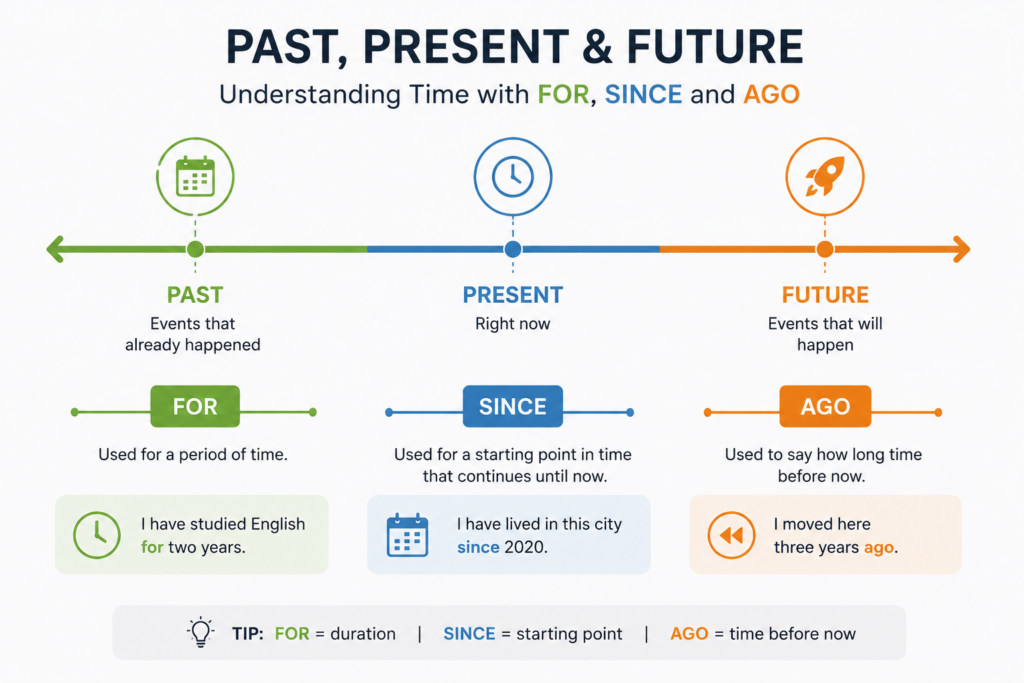
  • “For, Since, Ago” — Can You Get All 5 Right? (Preposition Quiz)

    As an English teacher, I have been creating content for both Korean learners and global English learners. This blog is where I share the grammar rules I cover in my lessons — and today’s quiz is about three words that confuse almost every English learner: for, since, and ago.

    No rules first. Just the quiz. 👇


    Quiz Time! 🎯


    Question 1: “I have lived here ___ 2019.”

    a) for b) ago c) since


    Question 2: “She left ___ two hours ___.”

    a) since / ago b) two / for c) — / ago


    Question 3: “I haven’t eaten ___ three hours.”

    a) since b) for c) ago


    Question 4: “He started learning English ___ he was a child.”

    a) ago b) for c) since


    Question 5: “We met a long time ___.”

    a) since b) for c) ago


    Drop your answers in the comments! 👇


    Now let’s check! 🎉


    Q1: c) since “I have lived here since 2019.” → SINCE = specific point in time (2019 is a fixed moment)


    Q2: c) — / ago “She left two hours ago.” → AGO = looking back from now (two hours back in time)


    Q3: b) for “I haven’t eaten for three hours.” → FOR = duration (three hours is a length of time)


    Q4: c) since “He started learning English since he was a child.” → SINCE = from a point in time continuing to now


    Q5: c) ago “We met a long time ago.” → AGO = a point in the past, looking back from now


    The simple rule 🔍

    • FOR = duration → “for three hours / for two years”
    • SINCE = specific starting point → “since 2019 / since Monday”
    • AGO = looking back from now → “two hours ago / a long time ago”

    How did you score?

    • 5/5 → Grammar pro! 🏆
    • 3-4/5 → Almost there! 💪
    • 1-2/5 → Now you know — try again! 😊

    Drop your score in the comments! 👇


    Want to learn more natural English?

    Hi, I’m Yehs Sam 👋 I have been teaching English and creating content to help learners sound more natural and confident — for both Korean learners and global English learners.

    🐢⚡ Turtle ZeusSlow but surely, we get there.


    Is there a slang word or English expression you’ve always wanted to know? Drop it in the comments below — I’d love to cover it in my next post!

  • “In, On, At” — Can You Get All 5 Right? (Preposition Quiz)

    As an English teacher, I have been creating content for both Korean learners and global English learners. This blog is where I share the grammar rules I cover in my lessons — and today we’re doing something a little different.

    No rules first. No hints.

    Just you and the quiz. Let’s see how you do. 👇


    Quiz Time! 🎯

    Fill in the blank with in, on, or at.


    Question 1: “I’ll meet you ___ 3pm ___ Monday.”

    a) in / on b) at / on c) on / at


    Question 2: “She was born ___ 1995 ___ a rainy Tuesday.”

    a) in / on b) on / at c) at / in


    Question 3: “The keys are ___ the table ___ the kitchen.”

    a) at / in b) in / on c) on / in


    Question 4: “I always study ___ night ___ my room.”

    a) on / in b) at / in c) in / at


    Question 5: “We arrived ___ the airport ___ the morning.”

    a) at / in b) in / on c) on / at


    How many did you get? Drop your answers in the comments! 👇


    Now let’s check! 🎉


    Q1: b) at / on

    “I’ll meet you at 3pm on Monday.”

    AT = exact time (3pm is a specific point on the clock) → ON = specific day (Monday is a named day)


    Q2: a) in / on

    “She was born in 1995 on a rainy Tuesday.”

    IN = year (big time period — think zoom out) → ON = specific day (Tuesday is a named day)


    Q3: c) on / in

    “The keys are on the table in the kitchen.”

    ON = surface (the table is a flat surface) → IN = enclosed space (the kitchen is a room)


    Q4: b) at / in

    “I always study at night in my room.”

    AT = night (a specific time period, treated as a point) → IN = enclosed space (your room has walls around it)


    Q5: a) at / in

    “We arrived at the airport in the morning.”

    AT = specific location (the airport is a point on a map) → IN = general time period (morning is a broad time)


    The zoom lens trick 🔍

    Now that you’ve seen the answers:

    • IN = big picture → years, months, cities, enclosed spaces
    • ON = medium → specific days, dates, surfaces
    • AT = exact point → specific times, specific locations

    Next time you’re unsure — zoom in or zoom out. The right preposition will follow!


    How did you score?

    • 5/5 → Grammar pro! 🏆
    • 3-4/5 → Almost there! 💪
    • 1-2/5 → Now you know — try again! 😊

    Drop your score in the comments! Which one surprised you the most? 👇


    Want to learn more natural English?

    Hi, I’m Yehs Sam 👋 I have been teaching English and creating content to help learners sound more natural and confident — for both Korean learners and global English learners.

    🐢⚡ Turtle ZeusSlow but surely, we get there.


    Is there a slang word or English expression you’ve always wanted to know? Drop it in the comments below — I’d love to cover it in my next post!