Blog

  • “In vs Into” β€” Can You Get All 5 Right? (Preposition Quiz)

    As an English teacher, I have been creating content for both Korean learners and global English learners. This blog is where I share the grammar rules I cover in my lessons β€” and today’s quiz is about two words that look almost identical but mean something very different: in and into.

    No rules first. Just the quiz. πŸ‘‡


    Quiz Time! 🎯


    Question 1: “She walked ___ the room.”

    a) in b) into c) both work


    Question 2: “He is sitting ___ the car.”

    a) into b) in c) both work


    Question 3: “The cat jumped ___ the box.”

    a) in b) into c) both work


    Question 4: “I left my keys ___ the kitchen.”

    a) into b) in c) both work


    Question 5: “She poured the water ___ the glass.”

    a) in b) into c) both work


    Drop your answers in the comments! πŸ‘‡


    Now let’s check! πŸŽ‰


    Q1: b) into “She walked into the room.” β†’ INTO = movement from outside to inside (she was outside, now she’s inside)


    Q2: b) in “He is sitting in the car.” β†’ IN = already inside, no movement (he’s already there)


    Q3: b) into “The cat jumped into the box.” β†’ INTO = movement (the cat moved from outside the box to inside)


    Q4: b) in “I left my keys in the kitchen.” β†’ IN = location, no movement (the keys are just sitting there)


    Q5: b) into “She poured the water into the glass.” β†’ INTO = movement (water moved from outside to inside the glass)


    The simple rule πŸ”

    • IN = already inside, no movement β†’ state
    • INTO = moving from outside to inside β†’ action

    Ask yourself: is something moving or staying? Moving β†’ INTO Staying β†’ IN


    How did you score?

    • 5/5 β†’ Grammar pro! πŸ†
    • 3-4/5 β†’ Almost there! πŸ’ͺ
    • 1-2/5 β†’ Now you know β€” try again! 😊

    Drop your score in the comments! πŸ‘‡


    Want to learn more natural English?

    Hi, I’m Yehs Sam πŸ‘‹ I have been teaching English and creating content to help learners sound more natural and confident β€” for both Korean learners and global English learners.

    🐒⚑ Turtle Zeus β€” Slow but surely, we get there.


    Is there a slang word or English expression you’ve always wanted to know? Drop it in the comments below β€” I’d love to cover it in my next post!
  • “To vs For” β€” Can You Get All 5 Right? (Preposition Quiz)

    As an English teacher, I have been creating content for both Korean learners and global English learners. This blog is where I share the grammar rules I cover in my lessons β€” and today’s quiz is about two words that look simple but trip people up all the time: to and for.

    No rules first. Just the quiz. πŸ‘‡


    Quiz Time! 🎯


    Question 1: “I bought this gift ___ you.”

    a) to b) for c) both work


    Question 2: “She explained the answer ___ me.”

    a) for b) to c) both work


    Question 3: “He went to the store ___ some milk.”

    a) to b) for c) both work


    Question 4: “Can you do this favor ___ me?”

    a) to b) for c) both work


    Question 5: “I sent a message ___ her.”

    a) for b) to c) both work


    Drop your answers in the comments! πŸ‘‡


    Now let’s check! πŸŽ‰


    Q1: b) for “I bought this gift for you.” β†’ FOR = benefit (you benefit from receiving the gift)


    Q2: b) to “She explained the answer to me.” β†’ TO = direction of communication (the explanation went toward me)


    Q3: b) for “He went to the store for some milk.” β†’ FOR = purpose (milk is the reason he went)


    Q4: b) for “Can you do this favor for me?” β†’ FOR = benefit (doing something that helps me)


    Q5: b) to “I sent a message to her.” β†’ TO = direction (the message traveled toward her)


    The simple rule πŸ”

    • TO = direction β†’ something moves toward someone
    • FOR = benefit or purpose β†’ someone gains something or there’s a reason

    How did you score?

    • 5/5 β†’ Grammar pro! πŸ†
    • 3-4/5 β†’ Almost there! πŸ’ͺ
    • 1-2/5 β†’ Now you know β€” try again! 😊

    Drop your score in the comments! πŸ‘‡


    Want to learn more natural English?

    Hi, I’m Yehs Sam πŸ‘‹ I have been teaching English and creating content to help learners sound more natural and confident β€” for both Korean learners and global English learners.

    🐒⚑ Turtle Zeus β€” Slow but surely, we get there.


    Is there a slang word or English expression you’ve always wanted to know? Drop it in the comments below β€” I’d love to cover it in my next post!

  • “For, Since, Ago” β€” Can You Get All 5 Right? (Preposition Quiz)

    As an English teacher, I have been creating content for both Korean learners and global English learners. This blog is where I share the grammar rules I cover in my lessons β€” and today’s quiz is about three words that confuse almost every English learner: for, since, and ago.

    No rules first. Just the quiz. πŸ‘‡


    Quiz Time! 🎯


    Question 1: “I have lived here ___ 2019.”

    a) for b) ago c) since


    Question 2: “She left ___ two hours ___.”

    a) since / ago b) two / for c) β€” / ago


    Question 3: “I haven’t eaten ___ three hours.”

    a) since b) for c) ago


    Question 4: “He started learning English ___ he was a child.”

    a) ago b) for c) since


    Question 5: “We met a long time ___.”

    a) since b) for c) ago


    Drop your answers in the comments! πŸ‘‡


    Now let’s check! πŸŽ‰


    Q1: c) since “I have lived here since 2019.” β†’ SINCE = specific point in time (2019 is a fixed moment)


    Q2: c) β€” / ago “She left two hours ago.” β†’ AGO = looking back from now (two hours back in time)


    Q3: b) for “I haven’t eaten for three hours.” β†’ FOR = duration (three hours is a length of time)


    Q4: c) since “He started learning English since he was a child.” β†’ SINCE = from a point in time continuing to now


    Q5: c) ago “We met a long time ago.” β†’ AGO = a point in the past, looking back from now


    The simple rule πŸ”

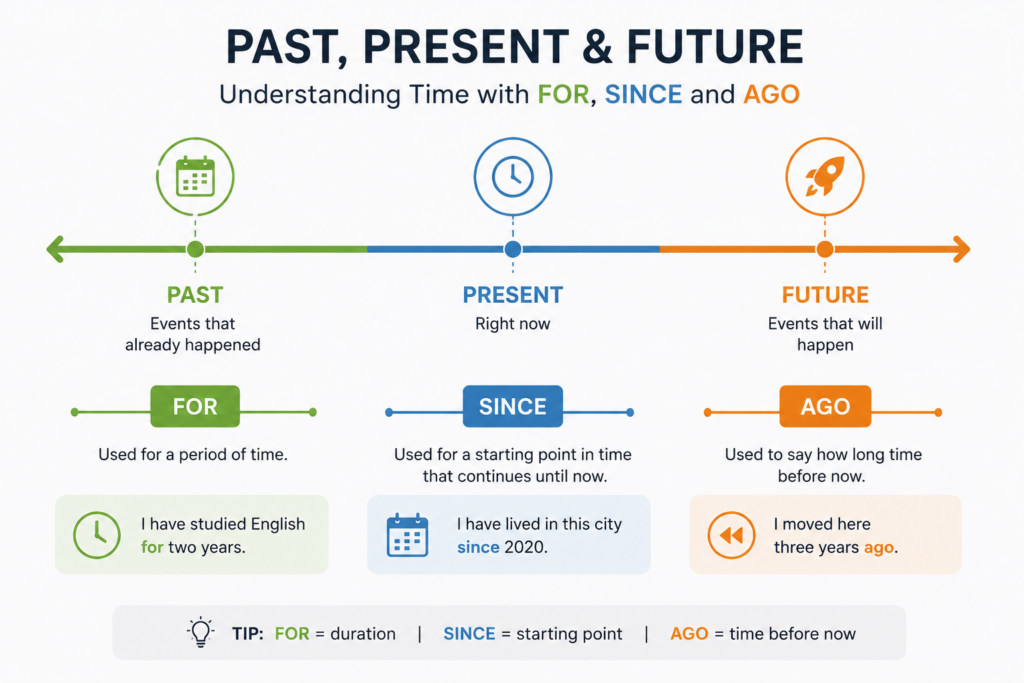
    • FOR = duration β†’ “for three hours / for two years”
    • SINCE = specific starting point β†’ “since 2019 / since Monday”
    • AGO = looking back from now β†’ “two hours ago / a long time ago”

    How did you score?

    • 5/5 β†’ Grammar pro! πŸ†
    • 3-4/5 β†’ Almost there! πŸ’ͺ
    • 1-2/5 β†’ Now you know β€” try again! 😊

    Drop your score in the comments! πŸ‘‡


    Want to learn more natural English?

    Hi, I’m Yehs Sam πŸ‘‹ I have been teaching English and creating content to help learners sound more natural and confident β€” for both Korean learners and global English learners.

    🐒⚑ Turtle Zeus β€” Slow but surely, we get there.


    Is there a slang word or English expression you’ve always wanted to know? Drop it in the comments below β€” I’d love to cover it in my next post!

  • “In, On, At” β€” Can You Get All 5 Right? (Preposition Quiz)

    As an English teacher, I have been creating content for both Korean learners and global English learners. This blog is where I share the grammar rules I cover in my lessons β€” and today we’re doing something a little different.

    No rules first. No hints.

    Just you and the quiz. Let’s see how you do. πŸ‘‡


    Quiz Time! 🎯

    Fill in the blank with in, on, or at.


    Question 1: “I’ll meet you ___ 3pm ___ Monday.”

    a) in / on b) at / on c) on / at


    Question 2: “She was born ___ 1995 ___ a rainy Tuesday.”

    a) in / on b) on / at c) at / in


    Question 3: “The keys are ___ the table ___ the kitchen.”

    a) at / in b) in / on c) on / in


    Question 4: “I always study ___ night ___ my room.”

    a) on / in b) at / in c) in / at


    Question 5: “We arrived ___ the airport ___ the morning.”

    a) at / in b) in / on c) on / at


    How many did you get? Drop your answers in the comments! πŸ‘‡


    Now let’s check! πŸŽ‰


    Q1: b) at / on

    “I’ll meet you at 3pm on Monday.”

    β†’ AT = exact time (3pm is a specific point on the clock) β†’ ON = specific day (Monday is a named day)


    Q2: a) in / on

    “She was born in 1995 on a rainy Tuesday.”

    β†’ IN = year (big time period β€” think zoom out) β†’ ON = specific day (Tuesday is a named day)


    Q3: c) on / in

    “The keys are on the table in the kitchen.”

    β†’ ON = surface (the table is a flat surface) β†’ IN = enclosed space (the kitchen is a room)


    Q4: b) at / in

    “I always study at night in my room.”

    β†’ AT = night (a specific time period, treated as a point) β†’ IN = enclosed space (your room has walls around it)


    Q5: a) at / in

    “We arrived at the airport in the morning.”

    β†’ AT = specific location (the airport is a point on a map) β†’ IN = general time period (morning is a broad time)


    The zoom lens trick πŸ”

    Now that you’ve seen the answers:

    • IN = big picture β†’ years, months, cities, enclosed spaces
    • ON = medium β†’ specific days, dates, surfaces
    • AT = exact point β†’ specific times, specific locations

    Next time you’re unsure β€” zoom in or zoom out. The right preposition will follow!


    How did you score?

    • 5/5 β†’ Grammar pro! πŸ†
    • 3-4/5 β†’ Almost there! πŸ’ͺ
    • 1-2/5 β†’ Now you know β€” try again! 😊

    Drop your score in the comments! Which one surprised you the most? πŸ‘‡


    Want to learn more natural English?

    Hi, I’m Yehs Sam πŸ‘‹ I have been teaching English and creating content to help learners sound more natural and confident β€” for both Korean learners and global English learners.

    🐒⚑ Turtle Zeus β€” Slow but surely, we get there.


    Is there a slang word or English expression you’ve always wanted to know? Drop it in the comments below β€” I’d love to cover it in my next post!

  • “Cost an Arm and a Leg” β€” What It Means and How to Use It

    As an English teacher, I have been creating content for both Korean learners and global English learners. This blog is where I share the expressions and idioms I cover in my lessons β€” and today’s expression is one you’ll use every time something is way too expensive: “Cost an arm and a leg.”


    What does “cost an arm and a leg” mean?

    “Cost an arm and a leg” means something is extremely expensive β€” so expensive that it feels like you’re giving up a part of your body to pay for it.

    You use it when the price of something shocks you or feels completely unreasonable.


    Real life examples:

    1. “That new iPhone costs an arm and a leg β€” I’ll wait for the price to drop.”
    2. “Dinner at that restaurant cost us an arm and a leg but it was worth it.”
    3. “Flying business class costs an arm and a leg.”
    4. “I wanted to buy a house in Seoul but it costs an arm and a leg.”
    5. “Good quality coffee doesn’t have to cost an arm and a leg.”

    Where did this come from?

    This expression became popular in the 20th century. The idea is simple β€” your arms and legs are the most valuable things you have. If something costs that much, it must be incredibly expensive.


    Similar expressions:

    • “Break the bank” β€” spend more money than you can afford
    • “Doesn’t come cheap” β€” something is expensive
    • “Pricey” β€” informal word for expensive

    Quick recap:

    Cost an arm and a leg = extremely expensive. Next time you see a shocking price tag, you know exactly what to say! πŸ’Έ


    Want to learn more natural English?

    Hi, I’m Yehs Sam πŸ‘‹ I have been teaching English and creating content to help learners sound more natural and confident β€” for both Korean learners and global English learners.

    🐒⚑ Turtle Zeus β€” Slow but surely, we get there.


    Is there a slang word or English expression you’ve always wanted to know? Drop it in the comments below β€” I’d love to cover it in my next post!

  • “Bite the Bullet” β€” What It Means and How to Use It

    As an English teacher, I have been creating content for both Korean learners and global English learners. This blog is where I share the expressions and idioms I cover in my lessons β€” and today’s expression is one you’ll use when life gets tough: “Bite the bullet.”


    What does “bite the bullet” mean?

    “Bite the bullet” means to endure a painful or difficult situation with courage β€” even when you don’t want to.

    It means pushing through something hard because you have no other choice.


    Real life examples:

    1. “I hate going to the dentist but I just had to bite the bullet and make an appointment.”
    2. “The project was stressful but we bit the bullet and finished it on time.”
    3. “Just bite the bullet and apologize β€” it’ll make things better.”
    4. “She bit the bullet and told her boss she needed a raise.”
    5. “Sometimes you just have to bite the bullet and do the hard thing.”

    Where did this come from?

    This expression comes from old battlefield medicine. Before modern anesthesia, soldiers who needed surgery would literally bite down on a bullet to endure the pain. It was their way of getting through something unbearable.


    Similar expressions:

    • “Tough it out” β€” push through something difficult
    • “Grin and bear it” β€” endure something unpleasant without complaining
    • “Take the plunge” β€” do something scary or difficult decisively

    Quick recap:

    Bite the bullet = face something hard and get through it with courage. We all have moments where we just have to bite the bullet β€” and come out stronger on the other side. πŸ’ͺ


    Want to learn more natural English?

    Hi, I’m Yehs Sam πŸ‘‹ I have been teaching English and creating content to help learners sound more natural and confident β€” for both Korean learners and global English learners.

    🐒⚑ Turtle Zeus β€” Slow but surely, we get there.


    Is there a slang word or English expression you’ve always wanted to know? Drop it in the comments below β€” I’d love to cover it in my next post!

  • “Under the Weather” β€” What It Means and How to Use It

    As an English teacher, I have been creating content for both Korean learners and global English learners. This blog is where I share the expressions and idioms I cover in my lessons β€” and today’s expression is one you’ll need whenever you’re not feeling your best: “Under the weather.”


    What does “under the weather” mean?

    “Under the weather” means feeling sick or unwell.

    You don’t have to be seriously ill β€” it just means you’re not feeling 100%. A little tired, a little sick, not quite yourself.


    Real life examples:

    1. “I can’t come to work today β€” I’m feeling a little under the weather.”
    2. “She looked under the weather at the party last night.”
    3. “I’ve been under the weather all week β€” probably just a cold.”
    4. “Are you okay? You seem a bit under the weather today.”
    5. “He cancelled his plans because he was feeling under the weather.”

    Where did this come from?

    This expression originally came from sailing. When sailors felt seasick, they would go below deck to be sheltered from the bad weather. Being “under the weather” meant hiding from the storm β€” and feeling miserable while doing it.


    Similar expressions:

    • “Not feeling well” β€” simple and direct
    • “Off color” β€” British English for feeling slightly ill
    • “Out of sorts” β€” not feeling quite right

    Quick recap:

    Under the weather = feeling sick or unwell. Use it when you’re not seriously ill but just not at your best. It sounds natural and very native! 🀧


    Want to learn more natural English?

    Hi, I’m Yehs Sam πŸ‘‹ I have been teaching English and creating content to help learners sound more natural and confident β€” for both Korean learners and global English learners.

    🐒⚑ Turtle Zeus β€” Slow but surely, we get there.


    Is there a slang word or English expression you’ve always wanted to know? Drop it in the comments below β€” I’d love to cover it in my next post!

  • “Hit the Sack” β€” What It Means and How to Use It Naturally

    As an English teacher, I have been creating content for both Korean learners and global English learners. This blog is where I share the expressions and idioms I cover in my lessons β€” and today’s expression is one you’ll use every single day: “Hit the sack.”


    What does “hit the sack” mean?

    “Hit the sack” means to go to bed or to go to sleep.

    It has nothing to do with hitting anything! A “sack” was an old word for a mattress or sleeping bag β€” so “hitting the sack” simply meant lying down to sleep.


    Real life examples:

    1. “I’m exhausted. I’m going to hit the sack early tonight.”
    2. “It’s almost midnight β€” time to hit the sack!”
    3. “He hit the sack as soon as he got home from work.”
    4. “You should hit the sack. You have an early morning tomorrow.”
    5. “I tried to stay up but ended up hitting the sack at 9pm.”

    When do you use it?

    Use it in casual, everyday conversation with friends and family. It’s friendly, natural, and very commonly used by native speakers.


    Similar expressions:

    • “Hit the hay” β€” same meaning, also very common
    • “Call it a night” β€” deciding to end the evening and go to sleep
    • “Catch some Z’s” β€” get some sleep

    Quick recap:

    Hit the sack = go to sleep. Simple, natural, and used every day by native English speakers. Try using it tonight! 😴


    Want to learn more natural English?

    Hi, I’m Yehs Sam πŸ‘‹ I have been teaching English and creating content to help learners sound more natural and confident β€” for both Korean learners and global English learners.

    🐒⚑ Turtle Zeus β€” Slow but surely, we get there.


    Is there a slang word or English expression you’ve always wanted to know? Drop it in the comments below β€” I’d love to cover it in my next post!

  • “Break a Leg” β€” What Does It Mean and When Do You Use It?

    As an English teacher, I have been creating content for both Korean learners and global English learners. This blog is where I share the expressions and idioms I cover in my lessons β€” and today’s expression is one that confuses almost every English learner the first time they hear it: “Break a leg.”


    What does “break a leg” mean?

    “Break a leg” means good luck β€” but you never actually want anyone to break their leg!

    It’s an idiom, which means the literal meaning and the real meaning are completely different.

    When someone is about to perform, give a presentation, or do something important, you say “break a leg” instead of “good luck.”


    Real life examples:

    1. “You’ve got your job interview today? Break a leg!”
    2. “The show starts in ten minutes β€” break a leg out there!”
    3. “I heard you have a big exam tomorrow. Break a leg!”
    4. “She texted me ‘break a leg’ before my presentation and it made me smile.”
    5. “Instead of saying good luck, try saying break a leg β€” it sounds more natural!”

    Where did this expression come from?

    There are a few theories, but the most popular one comes from the theater world. Performers believed that saying “good luck” directly would actually bring bad luck β€” so they said the opposite instead.

    Over time, “break a leg” became the standard way to wish someone well before a big moment.


    Similar expressions:

    • “You’ve got this” β€” I believe in you
    • “Knock ’em dead” β€” do an amazing job
    • “Go get ’em” β€” go do your best

    Quick recap:

    Break a leg = good luck. Use it before performances, interviews, exams, or any big moment. It sounds natural, warm, and very native! 🎭


    Want to learn more natural English?

    Hi, I’m Yehs Sam πŸ‘‹ I have been teaching English and creating content to help learners sound more natural and confident β€” for both Korean learners and global English learners.

    🐒⚑ Turtle Zeus β€” Slow but surely, we get there.


    Is there a slang word or English expression you’ve always wanted to know? Drop it in the comments below β€” I’d love to cover it in my next post!

  • What Is the “Talking Stage”? (And How Long Is Too Long?)

    As an English teacher, I have been creating content for both Korean learners and global English learners. This blog is where I share the expressions and slang I cover in my lessons β€” and today’s word is something almost everyone has been through: the talking stage.


    What is the “talking stage”?

    The talking stage is the period before two people officially start dating. You’re getting to know each other, texting every day, maybe going on dates β€” but there’s no official label yet.

    It’s exciting. It’s nerve-wracking. And sometimes, it goes on way too long.


    Real life examples:

    1. “We’ve been in the talking stage for two months β€” I don’t know where this is going.”
    2. “I hate the talking stage. Just tell me if you like me or not.”
    3. “We met online and have been talking for weeks β€” are we dating yet?”
    4. “The talking stage is fun until someone catches feelings and the other doesn’t.”
    5. “How do you move from the talking stage to an actual relationship?”

    How long should the talking stage last?

    • Normal: 2 weeks to 2 months
    • Too long: 3+ months with no progress
    • Red flag: They keep you in the talking stage forever β†’ that’s benching

    Similar expressions:

    • Situationship β€” stuck between talking and dating with no label
    • Benching β€” kept as a backup, never moves forward
    • Getting to know each other β€” more casual version of talking stage

    Quick recap:

    Talking stage = the exciting but confusing time before official dating. Enjoy it β€” but don’t let anyone keep you there forever.


    Want to learn more natural English?

    Hi, I’m Yehs Sam πŸ‘‹ I have been creating content to help learners sound more natural and confident β€” for both Korean learners and global English learners.

    🐒⚑ Turtle Zeus β€” Slow but surely, we get there.


    Is there a slang word or English expression you’ve always wanted to know? Drop it in the comments below β€” I’d love to cover it in my next post!